You’ve been thinking about it for a while. Maybe months. Maybe years.
You know you should be doing something. Your back is stiff every morning. You get winded going up stairs. You saw a photo of yourself and didn’t like what you noticed. Or your doctor said the words nobody wants to hear.
But every time you think about actually starting, it feels like too much. You don’t know what exercises to do. You don’t know how to use the machines. You picture walking into a Kamloops gym and everyone staring at you while you try to figure out where to even begin.
Here’s the thing. That feeling is normal. And it’s fixable.
Forget Everything You’ve Seen Online
The first mistake people make is going to YouTube or Instagram for a workout plan. You’ll find a thousand options. Push/pull/legs. Full body 3x a week. 12-week shred programs. HIIT circuits. Some guy telling you to do Bulgarian split squats while balancing on a medicine ball.
None of that is designed for you. It’s designed for clicks.
If you’ve never trained before, you don’t need a complicated program. You need the basics done well. Consistently. For long enough that your body adapts and your confidence builds.
That’s it.
Start With 3 Days a Week
Not 5. Not 6. Three.
Monday. Wednesday. Friday. Or whatever three days fit your schedule. The specific days don’t matter. What matters is that you can actually stick to it.
Each session doesn’t need to be an hour. Thirty to forty minutes is plenty when you’re starting out. Your body isn’t ready for more than that anyway. And honestly, 30 focused minutes beats 90 minutes of wandering around a gym floor wondering what to do next.
The 5 Movements That Matter
Every beginner program should be built around five basic movement patterns. Not specific exercises. Patterns.
1. Push (chest, shoulders, triceps)
Push-ups. Dumbbell press. Machine chest press. Doesn’t matter which one. Pick one you can do with decent form and stick with it.
2. Pull (back, biceps)
Cable rows. Dumbbell rows. Lat pulldown. Something that works the muscles you can’t see in the mirror. Most beginners skip pulling movements. Don’t.
3. Squat (quads, glutes)
Bodyweight squats. Goblet squats. Leg press. Your legs are the biggest muscles in your body. Training them burns the most calories and builds the most functional strength.
4. Hinge (hamstrings, glutes, lower back)
Romanian deadlifts. Hip hinges with a dumbbell. Kettlebell deadlifts. This is the movement pattern that protects your back. Especially important if you have a physical job. Kamloops has a lot of people working trades, construction, forestry. Your back needs this.
5. Carry/Core (midsection, grip, stability)
Farmer’s walks. Planks. Pallof press. These train the muscles that keep everything stable while the other muscles do the work.
Three days a week. One exercise from each pattern per session. Three sets of 8–12 reps. That’s your program. That’s all you need for the first 8–12 weeks.
The Stuff Nobody Tells Beginners
There’s a gap between “here’s your program” and “here’s what it actually feels like.” Let me fill that in.
You will be sore. Not injured. Sore. The first two weeks are the worst. Your legs will hate you after squats. This is called DOMS (delayed onset muscle soreness) and it’s completely normal. It fades as your body adapts. Don’t quit during this phase. Everyone goes through it.
You won’t see changes for 4–6 weeks. Your body changes slowly. The mirror lies for the first month. But around week 5–6, something shifts. Your clothes fit differently. You have more energy. You sleep better. The scale might not move much, but your body is changing composition. Fat down. Muscle up.
Form matters more than weight. Nobody cares how much you’re lifting. If you’re squatting with 15-pound dumbbells and doing it perfectly, you’re getting more out of that than the person doing 135 on the bar with terrible form and a sore back.
You don’t need supplements. You don’t need pre-workout. You don’t need BCAAs. You don’t need a fat burner. Eat enough protein. Drink water. Sleep. That’s your supplement stack for the first year.
The Gym Anxiety Problem
Let’s talk about it. Because it stops more people in Kamloops from starting than any other reason.
You picture yourself walking into a gym and not knowing what to do. Everyone else looks like they know exactly what they’re doing. You feel like an imposter. So you don’t go.
Here’s what’s actually happening in that gym. Half the people in there are just as confused as you. They’re doing the same three exercises every session because that’s all they know. The other half is too focused on their own workout to notice you.
Nobody is watching you. Nobody cares what weight you’re using. I promise.
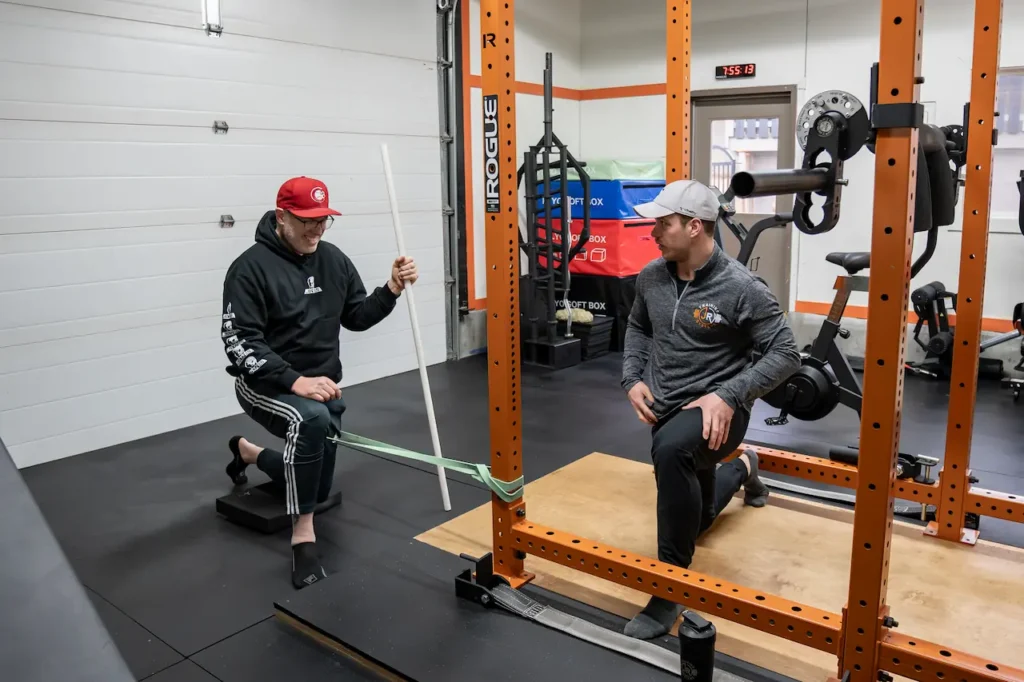
But if that anxiety is genuinely stopping you from starting, there are options. A private gym eliminates the problem entirely. My studio in Brocklehurst is one-on-one. No other clients. No audience. Just you and me working through your program in a quiet space near the airport. That’s why a lot of my clients chose this route. Not because they’re not tough enough for a regular gym. Because they wanted to learn the basics in a space where they could actually focus.
When to Get Help
You can absolutely start on your own. Millions of people do. The five movement patterns above will take you far if you’re consistent.
But there are situations where working with a personal trainer in Kamloops makes a real difference.
You have pain or an old injury. If your back locks up, your knee clicks, or your shoulder doesn’t go overhead without pain — don’t just push through it. Those compensations will get worse under load. A trainer who understands pain management can program around those issues.
You’ve tried before and quit. If this isn’t your first attempt, the problem probably isn’t motivation. It’s the plan. Or the environment. Or the lack of accountability. A trainer solves all three.
You want faster results. A custom-built fitness program will always outperform a generic one. Not because of some secret exercise. Because every set, rep, and rest period is dialed in for your body, your goals, and your schedule.
You’re over 50. Training in your 50s, 60s, 70s, or beyond is some of the most impactful training you can do. But it needs to be programmed differently. Recovery is slower. Joint health matters more. The risk of injury is higher if form isn’t right. I work with clients well into their 90s. Age isn’t a barrier. Bad programming is.
Just Start
The best program is the one you’ll actually do. Three days a week. Five movement patterns. Thirty minutes. That’s the starting line.
Don’t wait until January. Don’t wait until you “get in shape first.” Don’t wait until you feel ready. Nobody feels ready. You start, and then you figure it out as you go.
Kamloops has good weather for being active most of the year. Hot summers for hiking and lake days. Cold winters that make you want to stay inside. Use that indoor time to build a base. When spring hits and everyone heads out to Sun Peaks or the trails along the Thompson, you’ll be moving better than you have in years.
Not sure where to start? Book your first session at JR Training Systems. I’ll assess where you’re at, build a plan around your body, and take the guesswork out of getting started. Private gym in Brocklehurst. No crowds. No judgment.
FAQ
What should I wear to my first gym session?
Comfortable athletic clothes and clean shoes with flat soles. Running shoes work fine to start. Don’t overthink it.
How long before I see results from working out?
Most people notice improved energy and sleep within 2 weeks. Visible physical changes typically show up at 6–8 weeks with consistent training 3x per week.
Is it better to do cardio or weights as a beginner?
Strength training. It builds muscle, improves bone density, boosts metabolism, and makes everyday activities easier. Add cardio later if you want, but weights should be the foundation.