Most people in Kamloops book a massage because something feels tight. It helps for a day or two. Then the tightness comes back and they book another one.
If that’s your pattern, you’ve probably heard about fascia stretch therapy and wondered whether it’s the thing that finally sticks, or just a more expensive version of what you’re already doing.
I’m Jake Richardson. I’ve been a personal trainer in Kamloops since 2015 and I’m FST Level 2 certified. I also send clients to registered massage therapists on a regular basis, because a fair number of them are better off there. Here’s the honest comparison, including the parts most websites skip.
What’s the actual difference between fascia stretch therapy and massage?
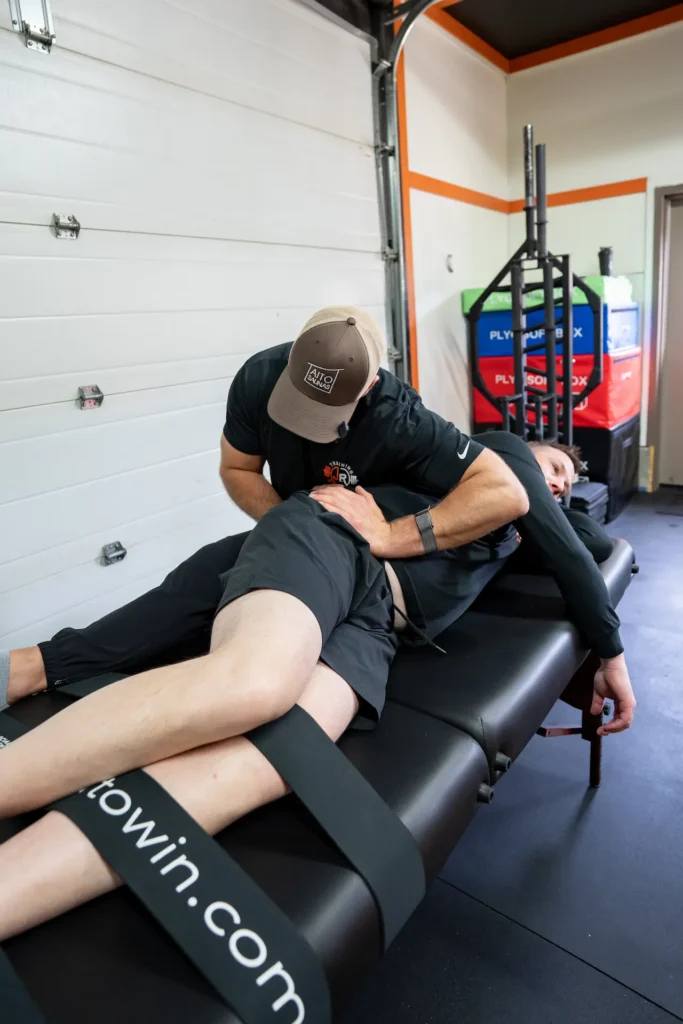
Fascia stretch therapy is assisted stretching done on a table, where a practitioner moves your arms and legs through wide ranges of motion and applies gentle traction to the joint. Massage therapy uses hands-on pressure, kneading, and friction on the muscle itself while you lie still.
The short version: massage works on tissue, FST works on movement.
Here’s how the two compare on the things that actually change your decision:
| Fascia Stretch Therapy | Massage Therapy | |
|---|---|---|
| What it targets | The joint capsule and whole fascial lines | Muscle tissue and specific trigger points |
| What you wear | Athletic clothes, you stay dressed | Undressed to your comfort, draped with a sheet |
| Your role | Active. Breathing cues and gentle resistance | Passive. You lie still |
| Best for | Stiffness and restricted range that has lasted months | Soreness, knots, stress, tension after hard training |
| How it feels | A strong stretch. It should not be painful | Direct pressure. Can be intense on a tight spot |
| Covered by benefits in BC | Only if the practitioner is an RMT, physio, or chiro. Not with me | Yes, with a registered massage therapist |
| How long it lasts | Fades unless you train the new range | Usually a few days, then the tension returns |
| At JR Training Systems | I deliver it, FST Level 2 certified | I refer you to an RMT in Kamloops |
Swipe the table sideways to see both columns.
Neither one is the upgrade of the other. They do different jobs. If you have one specific angry muscle, hands beat stretching. If you cannot get into the position at all, stretching beats hands.
Is fascia stretch therapy a gimmick?
It’s a fair question, and it’s the one nobody in this industry wants to answer. Search “is fascial stretch therapy worth it” and one of the top results in Canada is a forum thread where a therapy business owner calls fascia stretching a gimmick that just puts your body into awkward positions.
Here’s my honest take as someone certified in it.
The marketing around fascia has gotten ahead of the science. You’ll see claims that stretching “melts adhesions” or permanently reshapes connective tissue. The evidence for that is thin, and I don’t make those claims.
What I’d defend is narrower and better supported: a trained person can move your joints through ranges you can’t reach on your own, because your nervous system won’t let you relax into them by yourself. You leave with more usable range than you came in with. That’s real, and you can measure it in the room.
Whether that’s worth your money depends entirely on what you do with the range afterward. Which brings up the actual problem.
Why the loose feeling wears off in a day or two
Stretching changes what your body will allow in the moment. It doesn’t change what your body can control. That’s why relief from any stretch or massage tends to fade within hours or days.
Think of it this way. If your hips open up on my table but nothing in your week asks your hips to work in that new position, your nervous system has no reason to keep it. It defaults back to the range it knows how to stabilize. You go back to feeling stiff, and you book another appointment.
This is the part that matters, and it’s why I’m careful about selling stretch sessions on their own. The new range only becomes permanent when you build strength inside it. That means loading the position, not just visiting it.
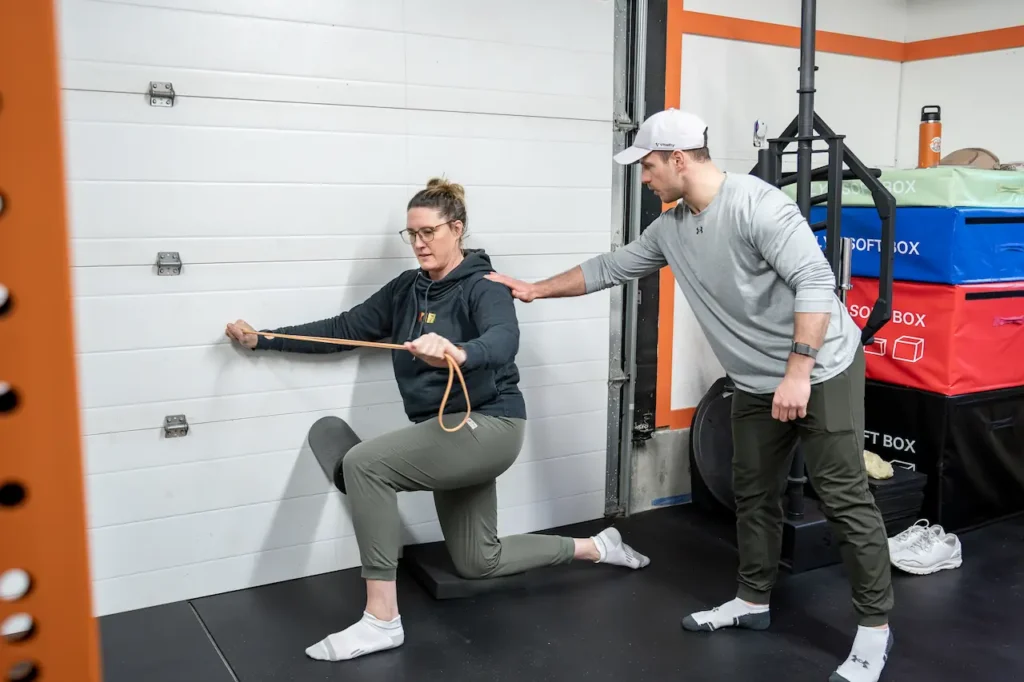
I’m a strength coach who does FST, not a stretch practitioner. So when a client’s hips open up, we then train them there. That follow-through is the difference between paying for relief every month and not needing to.
If your tightness has been around for months, treatment alone rarely settles it. Strength training in Kamloops is usually what makes the change hold.
Is fascia stretch therapy covered by insurance in Kamloops?
Coverage follows the practitioner’s licence, not the technique. If a registered massage therapist, physiotherapist, or chiropractor performs FST, you can usually claim it under your extended health plan. If a personal trainer performs it, you generally cannot.
That rule catches people off guard, so be clear about it before you book anywhere.
It’s worth saying plainly about my own practice: I’m FST Level 2 certified, but I’m not an RMT. Sessions with me are not claimable under extended health benefits. Several Kamloops clinics have dual-licensed practitioners on staff who can give you a receipt you can submit.
So if you have benefits sitting unused and cost is the deciding factor, book at a clinic. I’d rather tell you that than have you find out at checkout.
When you should book a massage instead
Book a registered massage therapist, not me, if any of these describe you:
- You want to relax. FST is not a spa treatment. You’ll be working. If the goal is to switch off for an hour, a massage does that better and usually costs less.
- You have one specific painful muscle. Direct pressure beats stretching for a localized knot.
- The injury is fresh. Anything that happened in the last 48 hours, with sharp pain or swelling, needs assessment first, not stretching.
- You have benefits to use. See above.
- You’re pregnant, post-surgical, or managing a diagnosed condition. Start with a regulated health professional who can assess you properly.
FST is a better fit when the problem is stiffness rather than pain, when it’s been going on for months rather than days, and when you want more range instead of less soreness.
How I use FST with Kamloops clients
I use fascia stretch therapy as one tool inside a training plan, not as a standalone service to sell you on repeat.
Most of the people I use it with fall into a few groups. Desk workers whose hips and shoulders have locked up after years of sitting. Hockey players who need range through the groin and hips before a season. People in their 60s, 70s, and 80s who want to keep hiking Kenna Cartwright without their back seizing up. Clients whose backs are stiff every single morning.
Roughly 80% of adults deal with back pain at some point, and a lot of what walks into my studio in Brocklehurst is exactly that: stiffness that’s been ignored until it started limiting things.
The pattern I use is simple. Assess how you actually move. Use FST to open the ranges that are restricted. Then program strength work so your body can hold what we opened. The stretching gets you the range. The training keeps it.
Everything happens one-on-one in a private facility, so there’s no audience and no waiting for equipment. If you want the detail on the treatment itself, I’ve written more on fascia stretch therapy in Kamloops, what FST actually is, and who it helps most. For chronic issues, my back pain management training and mobility training both build on the same approach.
FAQ
How often should you do fascia stretch therapy?
Clinics that publish guidance typically suggest at least three sessions to judge whether it’s working, then about once a month for maintenance. I’d rather see you less often than that and doing the strength work between sessions.
Can you do both FST and massage?
Yes, and plenty of my clients do. They’re complementary. A common pattern is FST for mobility on a regular schedule, and massage as needed when something specific flares up.
Does fascia stretch therapy hurt?
It shouldn’t. FST is designed to work below your pain threshold, because pain makes you guard and guarding defeats the point. You should feel a strong stretch, not a sharp one. Tell your practitioner if you’re bracing.
What’s the difference between FST and myofascial release?
Myofascial release applies sustained pressure to connective tissue with the hands while you stay still. FST moves the joint through a range with traction. Both target fascia, but one is pressure and one is movement.
Is fascia stretch therapy the same as what stretch studios offer?
Not always. FST is a specific certification through the Stretch to Win Institute with defined levels. Plenty of places advertise assisted stretching without that training. Ask which certification your practitioner holds and what level.
Which one should you book?
If you’re stiff, it’s been months, and you want range back, fascia stretch therapy is the better fit. If you’re sore, stressed, or have benefits to spend, book a registered massage therapist in Kamloops and don’t feel bad about it.
And whichever you pick, ask the harder question: what’s going to keep the change once you’re off the table? If nobody has an answer to that, you’ll be booking again in two weeks.
If you want to see how your hips and shoulders actually move, and what it would take to keep the range you get, book a session and we’ll assess it in person. Over 160 five-star Google reviews, one-on-one, in Kamloops’ only fully private training facility.